

Artificial Intelligence (AI) is no longer just a futuristic concept found in science fiction movies. Today, it powers everything from voice assistants and online shopping recommendations to self-driving cars and medical research. If you’ve ever wondered what AI really is or how it impacts your everyday life, you’re in the right place.
This beginner-friendly guide from Read Hub explains Artificial Intelligence in simple language, helping you understand the basics without technical jargon. Whether you’re a student, professional, or simply curious about technology, this guide will give you a solid foundation.

What Is Artificial Intelligence?
Artificial Intelligence is the ability of computers and machines to perform tasks that typically require human intelligence. These tasks include learning from data, recognizing speech, solving problems, understanding language, making decisions, and even creating content.
Instead of following only fixed instructions, AI systems improve over time by analyzing large amounts of information and identifying patterns.
Think of AI as software designed to “learn” rather than simply follow commands.

How Does Artificial Intelligence Work?
At its core, AI relies on three main components:
Data
AI learns from enormous amounts of information. The more quality data it receives, the better its predictions become.
Algorithms
Algorithms are sets of instructions that help AI analyze data and identify meaningful patterns.
Machine Learning
Machine Learning is a branch of AI where computers improve automatically through experience instead of being manually programmed for every situation.
Together, these technologies allow AI to recognize faces, translate languages, recommend products, and much more.

Types of Artificial Intelligence
1. Narrow AI
Also called Weak AI, this is the most common type today. It performs specific tasks exceptionally well.
Examples include:
- Virtual assistants
- Recommendation systems
- Spam filters
- Navigation apps
2. General AI
General AI refers to machines capable of performing any intellectual task that humans can do.
Although researchers continue working toward this goal, General AI does not yet exist.
3. Super AI
Super AI is a theoretical concept where machines become more intelligent than humans in every field.
Currently, this remains purely speculative.
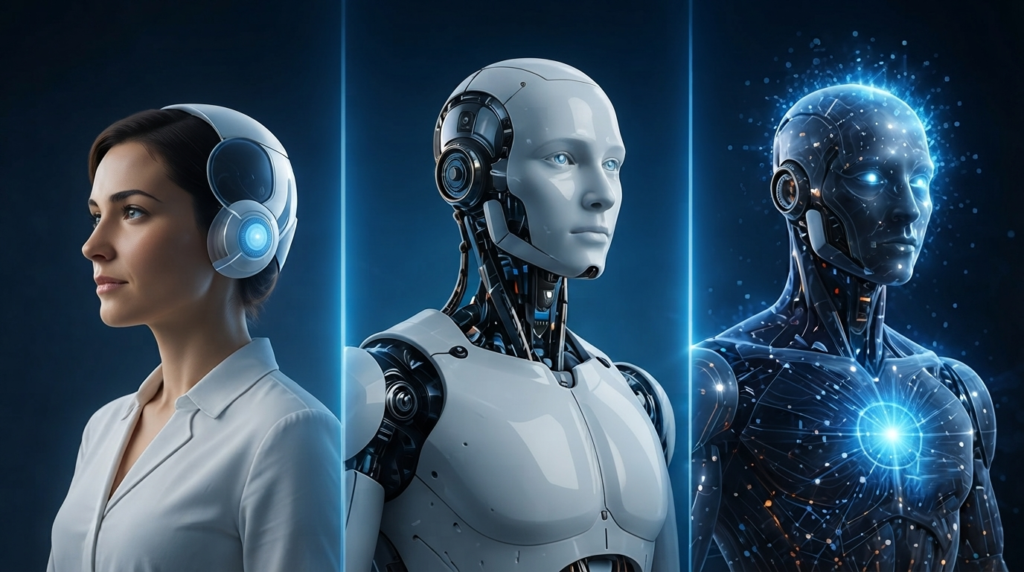
Common Applications of AI
Artificial Intelligence is already transforming countless industries.
Healthcare
- Disease detection
- Medical imaging
- Drug discovery
- Personalized treatment
Education
- Personalized learning
- AI tutors
- Automated grading
Business
- Customer support chatbots
- Sales forecasting
- Fraud detection
- Marketing automation
Finance
- Credit scoring
- Fraud prevention
- Investment analysis
Transportation
- Self-driving technology
- Traffic prediction
- Route optimization
Entertainment
Streaming platforms recommend movies and music based on your preferences using AI-powered recommendation engines.

Benefits of Artificial Intelligence
AI offers significant advantages across industries.
Increased Productivity
AI automates repetitive tasks, allowing people to focus on more valuable work.
Better Decision-Making
AI analyzes huge datasets within seconds, helping organizations make informed decisions.
Improved Accuracy
AI minimizes human errors in tasks such as medical diagnosis and quality inspection.
24/7 Availability
Unlike humans, AI-powered systems can operate around the clock.
Enhanced Customer Experience
Businesses use AI chatbots to provide instant support at any time.

Challenges and Risks
While AI offers many opportunities, it also presents challenges.
Privacy Concerns
AI systems often require large amounts of personal data.
Job Automation
Some repetitive jobs may become automated, creating workforce changes.
Bias
Poor-quality training data can produce unfair or inaccurate results.
Security
Cybercriminals can misuse AI if proper safeguards are not implemented.
Responsible AI development focuses on transparency, fairness, and ethical use.

AI vs Machine Learning vs Deep Learning
Many people use these terms interchangeably, but they have different meanings.
| Technology | Description |
|---|---|
| Artificial Intelligence | The broader field of creating intelligent machines. |
| Machine Learning | A subset of AI where systems learn from data. |
| Deep Learning | A specialized branch of Machine Learning using neural networks with multiple layers. |
In simple terms:
AI → Machine Learning → Deep Learning
Each builds upon the previous technology.

How to Start Learning AI
If you’re interested in Artificial Intelligence, begin with the fundamentals.
A practical learning path includes:
- Learn basic programming (Python is widely recommended).
- Understand mathematics fundamentals.
- Study Machine Learning concepts.
- Explore beginner AI courses.
- Practice with small projects.
- Learn data analysis.
- Stay updated with AI news and research.
The best way to learn AI is through consistent hands-on practice rather than memorizing theory.

The Future of Artificial Intelligence
Artificial Intelligence is expected to reshape nearly every industry over the coming years.
Future developments may include:
- Smarter healthcare systems
- More personalized education
- Fully autonomous vehicles
- Advanced robotics
- Faster scientific discoveries
- Improved business automation
- Enhanced cybersecurity
As AI evolves, understanding its capabilities and limitations will become an increasingly valuable skill for professionals across every field.

Conclusion
Artificial Intelligence is transforming the way we live, work, and communicate. While the technology may seem complex at first, understanding the basics makes it much easier to appreciate its impact on everyday life.
Whether you’re exploring AI out of curiosity or preparing for a future career, building a strong foundation today will help you stay ahead in tomorrow’s digital world. Here at Read Hub, our goal is to simplify complex topics and provide practical knowledge you can trust.
If you have any questions or concerns regarding this topic, feel free to contact us through our Contact Us page or reach out via the WhatsApp button available on Read Hub. We’re always happy to help!
FAQ
1. What is Artificial Intelligence in simple words?
Artificial Intelligence is technology that enables computers to perform tasks that normally require human intelligence, such as learning, reasoning, and problem-solving.
2. Is Artificial Intelligence difficult to learn?
No. Beginners can start with basic concepts before progressing to programming, Machine Learning, and practical AI projects.
3. What programming language is best for AI?
Python is the most popular language because of its simplicity and extensive AI libraries.
4. What is the difference between AI and Machine Learning?
AI is the broader concept of intelligent machines, while Machine Learning is a subset of AI that allows systems to learn from data automatically.
5. Is AI replacing human jobs?
AI automates certain repetitive tasks, but it also creates new career opportunities in technology, healthcare, education, and many other industries.
6. Can beginners learn AI without a computer science degree?
Yes. Many successful AI learners start with online courses, practical projects, and self-study without having a formal computer science background.