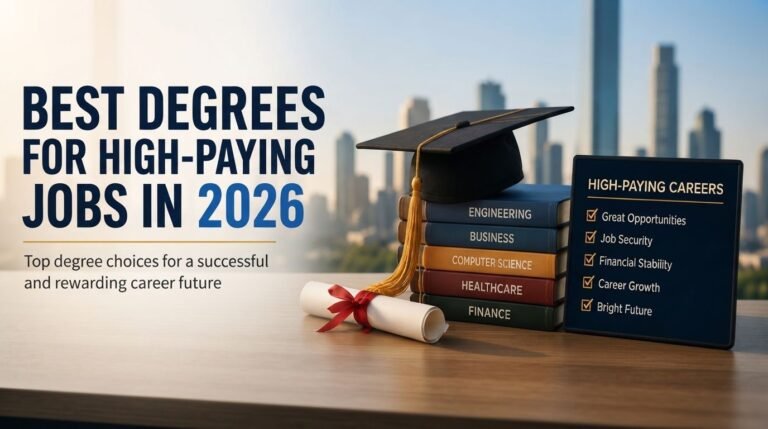

The job market is changing quickly, and the careers that are valuable today may look very different by 2030. Artificial intelligence, automation, cybersecurity, healthcare needs, digital services, and renewable energy are creating new opportunities across industries. If you’re planning your education or career, understanding these trends can help you make a smarter decision. The careers in demand by 2030 are expected to include technology-focused roles as well as professions that depend heavily on human judgment, communication, creativity, and specialized knowledge.

1. Artificial Intelligence and Machine Learning
Artificial intelligence and machine learning are expected to remain among the fastest-growing career areas through 2030 as businesses use AI for automation, customer service, research, marketing, software, and decision-making. Careers such as AI engineer, machine learning engineer, automation specialist, and AI product specialist can offer strong opportunities for people who develop programming, mathematics, statistics, and problem-solving skills. You don’t have to become an AI researcher immediately; learning programming fundamentals and gradually building knowledge of machine learning and modern AI tools can provide a practical starting point.

2. Data Science and Analytics
Businesses are collecting more data than ever, creating a growing need for professionals who can turn information into useful decisions. Data scientists, analysts, business intelligence specialists, and data engineers can work across industries such as finance, healthcare, technology, marketing, and retail. Learning skills such as SQL, statistics, spreadsheets, data visualization, and Python can help you enter this field. The important part is not simply understanding numbers but being able to explain what the data means and how it can help solve real business problems.

3. Cybersecurity
As businesses, governments, and individuals rely more heavily on digital systems, protecting information from cyber threats will remain a major priority. Cybersecurity careers include security analysts, security engineers, security consultants, incident responders, and other specialized roles. People interested in this field should build a strong understanding of networking, operating systems, cloud environments, security principles, and risk management. Cybersecurity can be particularly suitable for people who enjoy investigating problems, finding weaknesses, and continuously learning because digital threats are constantly evolving.

4. Software Development and Cloud Computing
Software will continue to play an important role in almost every industry, from banking and healthcare to education and entertainment. Although AI tools are changing how developers write code, businesses still need professionals who understand programming, application development, databases, APIs, cloud platforms, and system architecture. Starting with one programming language and learning the fundamentals properly is a better approach than trying to learn every new technology at once. Strong developers will increasingly combine technical knowledge with the ability to understand business requirements and solve practical problems.

5. Renewable Energy and Environmental Careers
The global shift toward cleaner energy is creating opportunities in renewable power, electric vehicles, energy storage, environmental engineering, and sustainability. Careers in this area can include renewable energy engineers, environmental engineers, energy technicians, project managers, and sustainability specialists. These roles are especially interesting for people who want to work with technology while contributing to large-scale environmental and infrastructure projects. As governments and businesses continue investing in cleaner energy systems, specialized technical skills in this sector could become increasingly valuable.

6. Healthcare and Health Services
Healthcare is expected to remain a strong career area because people will always need medical care, while aging populations and advances in healthcare technology continue to create new demands. Opportunities can be found in nursing, medicine, physical therapy, healthcare management, medical technology, and many other specialized professions. Technology may change how healthcare workers perform certain tasks, but skills such as communication, empathy, decision-making, and professional judgment remain essential. For students interested in a stable career with a direct impact on people’s lives, healthcare is an area worth considering.

7. Financial Technology
Financial technology, commonly known as FinTech, is combining traditional finance with software, artificial intelligence, data analytics, digital payments, and cybersecurity. This is creating opportunities for people who understand both financial services and technology. Careers can include FinTech engineering, financial data analysis, digital payments, risk technology, financial software development, and technology-focused product management. A strong understanding of finance combined with technical skills can be particularly useful because successful financial technology solutions need to be secure, practical, and designed around real customer needs.

8. Education and Human-Centered Careers
Not every future career will be based on advanced technology. Education, training, leadership, communication, career development, and other human-centered professions are also likely to remain important because people will continue to need guidance, learning, collaboration, and personal support. As technology changes workplaces, professionals who can teach others, communicate clearly, solve complex problems, and adapt to new situations may become even more valuable. The best approach is therefore not to choose between technology and human skills but to develop both, creating a career profile that can adapt as the workplace evolves.

How to Prepare for the Future Job Market
Preparing for 2030 does not mean trying to predict exactly which jobs will exist. A better strategy is to choose a career area that interests you and develop skills that remain useful as technology changes. Build strong fundamentals, gain practical experience through projects or internships, learn relevant digital tools, improve your communication and analytical abilities, and continue updating your knowledge. The World Economic Forum expects significant changes in workplace skills by 2030, which makes continuous learning an important part of long-term career development. Read Hub recommends focusing on becoming adaptable rather than searching for a career that is supposedly completely “future-proof.”
Conclusion
The careers in demand by 2030 are likely to cover a wide range of industries, including artificial intelligence, data science, cybersecurity, software development, renewable energy, healthcare, FinTech, and education. However, choosing a career should involve more than following a list of predicted jobs. Consider your interests, strengths, education opportunities, and the type of work you genuinely enjoy. Building strong technical and human skills while staying open to learning can give you a much better foundation for the changing job market. Read Hub provides practical information about careers, technology, education, and emerging trends to help you make more informed decisions about your future.
If you have any questions or concerns regarding this topic, feel free to contact us through our Contact Us page or reach out via the WhatsApp button available on Read Hub. We’re always happy to help!
FAQ
What careers will be in demand by 2030?
AI and machine learning, data science, cybersecurity, software development, healthcare, renewable energy, FinTech, and several human-centered professions are expected to remain important areas of employment.
Is AI a good career choice for the future?
AI is a promising career area because businesses across many industries are adopting artificial intelligence. However, strong programming, analytical, and problem-solving foundations are still important.
Will software developers still be needed in 2030?
Yes. AI is changing software development, but companies will continue to need professionals who can design, build, maintain, test, and evaluate software systems.
What skills will be important by 2030?
Technical skills such as AI, data analysis, cybersecurity, and digital technology will be valuable, while communication, analytical thinking, creativity, adaptability, and collaboration will remain important.
How can I prepare for future careers?
Choose a career direction, develop its core skills, gain practical experience, learn relevant technology, and continue improving your knowledge as industry requirements change.